
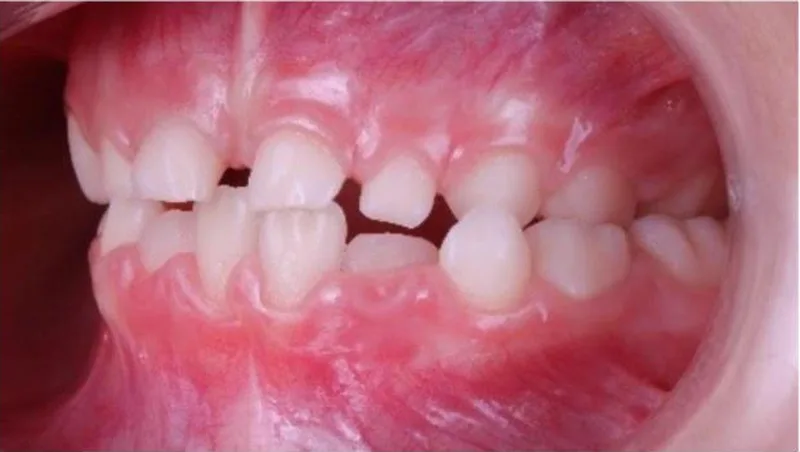
When to take a child to the orthodontist
The Spanish Orthodontic Society recommends a first check-up at around 6-7 years old, when the first permanent molars and incisors come through. At that age we can already see how the jaws are growing and whether there are problems with space, bite or habits. Often the check-up ends with "all is well, see you in a year"; other times, a short treatment in time avoids a long one later.
What dentofacial orthopaedics is
While the child is growing, we can guide the development of the jaws: widen a narrow palate, correct a crossbite, help a lower jaw that lags behind or hold back an upper jaw that grows too much. It is done with removable or fixed appliances adapted to each case, over a few months, taking advantage of growth. Once that window is missed, some of these corrections are only possible with surgery.
Habits, breathing and space
Thumb sucking, prolonged dummy use, mouth breathing or a poorly positioned tongue deform the palate and the bite. At the first check-up we detect them and, together with the paediatrician, ENT specialist or speech therapist when needed, treat them in time. We also watch the space for the permanent teeth: sometimes it is enough to keep it open when a baby tooth is lost too early.
The two phases of treatment
In some children we do an early first phase with orthopaedic appliances between the ages of 6 and 11, and a second phase of comprehensive orthodontics once all the permanent teeth have come through, from age 12, with braces or with clear aligners for teenagers. In others, it is enough to wait and do a single treatment in adolescence. We explain it with your child's study in front of you, without bringing forward treatments that aren't needed.
The 3D study, for children too
With an intraoral scanner we avoid paste moulds, which children find uncomfortable, and get a digital model in minutes. We reserve the CBCT, the three-dimensional X-ray, for cases where it adds something a conventional X-ray can't (impacted teeth, asymmetries, airway), with the lowest possible dose.
 Book via WhatsApp